
StruxaCheck
Shipping an App Store–approved AI product as a non-engineer


Live on the Apple App Store
Case Study
Executive Summary
StruxaCheck is an App Store–approved iOS application built by a non-engineer using no-code and low-code tools to help users understand Terms and Conditions and Privacy Policies before agreeing to them.
The project was designed under strict constraints, including no user accounts, no tracking, and no data retention, to prioritize user trust and platform compliance.
StruxaCheck passed Apple App Store review without changes to core functionality, demonstrating that disciplined scope, governance-aware design, and platform fluency are sufficient to ship production-grade AI products responsibly.
StruxaCheck is a consumer-facing iOS app that helps users understand Terms and Conditions and Privacy Policies before agreeing to them.
Built and shipped by a non-engineer using no-code and low-code tools, the app was designed to meet Apple App Store quality, privacy, and compliance standards without relying on a traditional engineering team.
Overview
Status: Live on the Apple App Store
Platform: iOS
Role: Product strategy, design decisions, platform compliance, release management
Download on the App Store
The Real Challenge
The challenge behind StruxaCheck was not “How do we summarize legal documents?”
The real challenge was this:
Can a non-engineer ship a consumer-facing AI product that meets App Store quality, privacy, and compliance standards without a traditional engineering team?
Most AI tools never face this test. They remain demos, internal tools, or web apps that avoid platform scrutiny. Apple’s App Store enforces real constraints around privacy disclosures, data handling, age ratings, and user trust.
StruxaCheck was built to answer that challenge directly.
No traditional backend engineering team
No custom machine learning infrastructure
No user accounts or authentication
Project Constraints and Why They Mattered
This project operated under deliberate constraints from day one:
These constraints were intentional design decisions. They ensured the product remained focused, compliant, and review-ready while minimizing downstream risk.
No analytics or advertising SDKs
No data retention beyond what was strictly necessary
High scrutiny due to AI and legal-related content
The Approach: No-Code, Not No Thinking
Intent-First Design
The product was scoped around a single user action: understanding policies before agreeing to them. Any feature that increased complexity, risk, or review friction was excluded from version one.
Platform-Aware Development
App Store review requirements were treated as product inputs. App Privacy disclosures, age ratings, and reviewer notes were aligned early to avoid rework.
Human Judgment Over Automation Hype
The app positions itself as informational, not authoritative. Risk signals and summaries are framed as decision support rather than legal advice.
Iterative Testing Through TestFlight
The app was tested and refined under real App Store conditions prior to public release.
Governance Built Into Product Design
Privacy and compliance decisions were made at the architecture level: no sign-in, no tracking, and no permanent storage of user-provided text. These choices simplified compliance and strengthened user trust.
What StruxaCheck Does
Paste policy text or provide a public URL
Select Terms and Conditions or Privacy Policy analysis
Receive a plain-language summary, a risk signal, and highlighted issues
Analysis completes within seconds. No account is required.
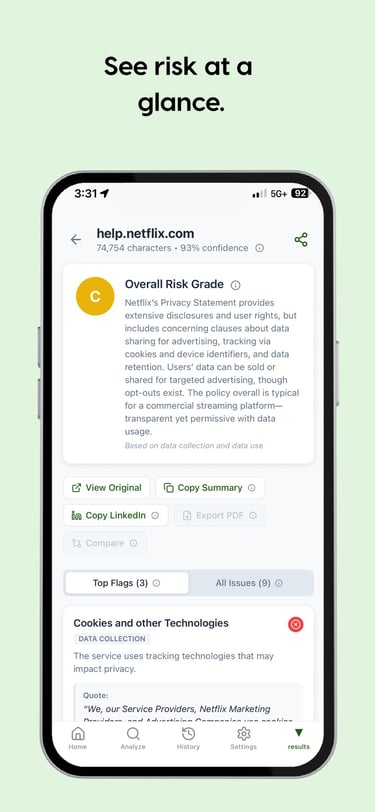
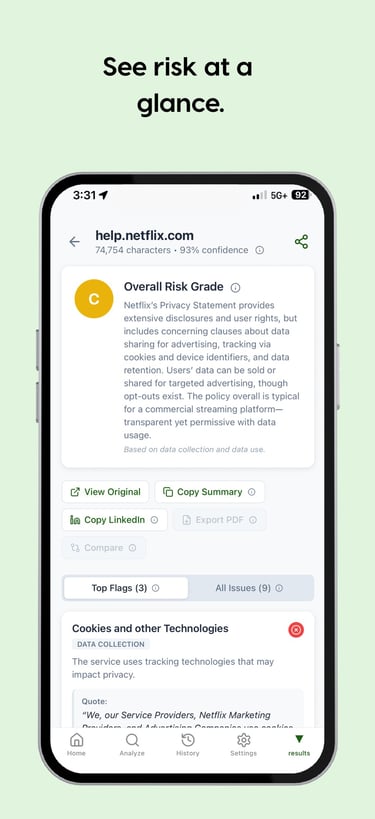
Example analysis output from the StruxaCheck iOS app.
App Store Review Outcome
Reviewed and approved under standard App Store AI and privacy guidelines.
StruxaCheck was approved and released on the Apple App Store without requiring changes to core functionality.
AI apps can pass App Store review without excessive data collection
No-code tools can support production-grade consumer products
Platform compliance can be navigated successfully by non-engineers
The approval validated both the product design and the governance decisions behind it.
Why This Case Study Matters
StruxaCheck is not just a consumer app. It is proof of a broader capability.
In many organizations, the bottleneck is no longer writing code. It is knowing what should be built, what should be avoided, and how to ship responsibly under real constraints.
This project demonstrates that those decisions can be made and executed without a traditional engineering background.
What Was Intentionally Not Built
To reduce risk, complexity, and review friction, the following were intentionally excluded:
User accounts or authentication
Cloud storage of analyzed documents
Behavioral analytics or tracking
Advertising or monetization features
Claims of legal accuracy or guarantees
Automated decision-making without clear human framing
Each exclusion was a product decision, not a technical limitation.
These exclusions were intentional product decisions, not technical limitations.
Tooling Stack (High-Level)
Live App
StruxaCheck is available on iOS.
No-code mobile app tooling for iOS deployment
Lightweight AI processing services
Web tooling for privacy and documentation
TestFlight for staged testing under real App Store conditions
The emphasis was responsible orchestration, not custom infrastructure.


Want to ship AI products that can pass real platform scrutiny?
Struxa partners with founders, operators, and teams to design and ship compliant, trust-first AI products.
The focus was on orchestration and restraint, not custom infrastructure.